A home battery is sized by three numbers: energy in kWh, which sets how long it lasts; power in kW, which sets how much can run at once; and starting current, which decides whether it can start your air conditioner or well pump. For scale, a 13.5 kWh battery, the median size paired with home solar in 2025 according to Lawrence Berkeley National Laboratory, would run the average US home for about 10 hours, or a refrigerator, lights, TV, microwave and router for about two days. The guides below run in the order most people need them, from that first estimate to a quote you can check.
Leaf & Watt sells and installs nothing, takes no referral fees and ranks no products. Product figures come from the makers’ datasheets, and worked examples label our assumptions. This page is general information, not professional, tax or legal advice.
Start with what a battery runs
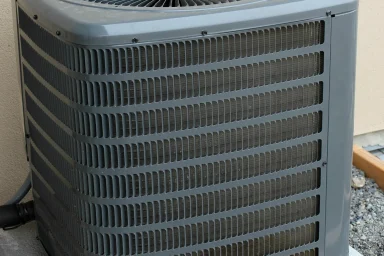
Think of the battery as a water tank: kWh is the size of the tank, kW the width of the tap. A big tank with a narrow tap can keep a refrigerator going for days but can’t start central air. Motors add a third test: compressors and pumps draw several times their running current for a moment when they start, listed on nameplates as locked rotor amps (LRA).
An electric water heater, electric heat or central air each uses more in a year than a refrigerator, lights, TVs and a microwave combined, so they decide hours versus days. Our guide to what a home battery runs and for how long works through each appliance and what solar adds during an outage. Read it first.
How long it lasts: run time
Run time is the energy you can use divided by how fast the house uses it. The average US residential customer bought 10,791 kWh in 2022 (EIA), about 29.6 kWh a day. At that rate a full 13.5 kWh battery lasts about 10 hours. An essentials-only load of roughly 6 to 7 kWh a day stretches the same battery to around two days.
The charge when the outage starts matters as much as size: a battery that also does daily work is often partly empty when the grid drops. Tesla’s app lets owners keep a backup reserve anywhere from 0% to 80% (Tesla, Backup Reserve). In our worked example, a battery sitting at a 20% reserve has only about 5½ hours of essentials left. The battery run time calculator takes your own loads, starting charge and solar, and shows every step.
The average US customer was without power for 262.6 minutes in 2025, about 4.4 hours, counting major events (EIA Electric Power Annual, Table 11.3). In 2024, a heavy hurricane year, the average was about 11 hours. Those are yearly averages; size for the long outage you want to ride out.
Sizing: kWh, kW and starting current
Our calculator checks all three numbers against the battery on your quote. In its example, essentials plus a 3-ton air conditioner for 4 hours need about 19 kWh usable for a 24-hour outage when new, 27 kWh at a 70% end-of-warranty floor, 4.4 kW and about 89 amps of starting current. With small modular batteries, power or starting current can set the count before energy does. Run the home battery size calculator with your own nameplate LRA.
Adding batteries doesn’t always add power. Tesla’s Powerwall 3 datasheet counts Expansion units toward storage only: they make the battery last longer, not run more at once.
Essentials or the whole house
On a quote, “whole-home backup” usually describes the wiring: every circuit in the main panel stays connected in an outage. It doesn’t say how much the system can carry. Essentials backup moves chosen circuits to a backed-up subpanel and leaves the rest dark.
In our example all-electric house, running the air conditioner, water heater, range, EV charger and well pump at once would need about 34 kW, three Powerwall 3 units’ worth of continuous output. Some systems sold as whole-home pass that test only by switching big loads off automatically. Our guide to what whole-home battery backup takes works the three tests with datasheet figures and prices the ways to build it.
A battery without solar
A battery works without panels: it charges from the grid and takes over in an outage. The limit is recharging: a long outage drains it once, and it stays empty until the grid returns. Some systems, Tesla’s among them, don’t charge from a generator.
For bill savings, at 90% round-trip efficiency a battery breaks even only when peak costs more than about 1.11 times off-peak, so on a flat rate it loses a little money. Our worked example on Southern California Edison’s TOU-D-PRIME plan saves about $760 a year, a simple payback of about 20.6 years against a $15,647 typical installed price. See home battery backup without solar for the formula and the programs that pay standalone batteries.
Comparing batteries by spec sheet
Compare batteries on usable kWh, continuous kW, motor-start rating, fit with your existing solar inverter and warranty terms before you compare price. One Powerwall 3 lists 13.5 kWh, up to 11.5 kW and 185 LRA. One alternative stores more but supplies less than half that power; others match it only by stacking units. Our Powerwall alternatives compared by spec sheet sets nine batteries against it on their makers’ own documents, with no ranking.
Read the warranty conditions too: Tesla’s and FranklinWH’s can drop to 4 years if the battery stays offline or unregistered.
Tesla shows no US price online. Published estimates for one installed Powerwall 3 mostly run about $13,000 to $16,500 before incentives, and our own build-up from a dated retail listing comes to $12,598 to $14,113. The page on what a Powerwall 3 costs and what adds to it covers the backup hardware, panel upgrades and Expansion units.
Battery or generator
A standby generator usually costs less to buy and runs as long as it has fuel. A battery costs more up front, almost nothing per outage, and stops when its charge runs out. In our example of three 8-hour outages a year, a 22 kW propane generator works out at about $485 per outage over 10 years, equipment included, and a 13.5 kWh battery at about $523. At 72 hours the battery looks cheaper only because it covers 13.5 of them and leaves the house dark for the rest.
The battery backup vs generator calculator runs your own outages, load and fuel prices through both. If you use a generator, the CDC says never to run one inside a home, basement or garage, or less than 20 feet from any window, door or vent (CDC).
Cost, and the credit that ended
EnergySage, a commercial quote marketplace, puts a typical installed battery at $15,647 for 13.5 kWh before incentives, from quotes in the first half of 2026 (EnergySage, updated 13 July 2026). Our solar battery cost guide sets the published figures side by side and builds one up line by line.
The 30% federal homeowner credit no longer applies. Under 26 USC 25D(h) it does not cover expenditures made after 31 December 2025, and an expenditure counts as made when installation is completed. Lease and PPA providers may be able to claim the business credit under 48E on storage of at least 5 kWh; that is the provider’s credit, and how much reaches your price is up to the contract. See what ended and what’s left of the solar tax credit, and battery rebates and VPP programs by state for the separate state and utility programs. A tax professional decides how the rules apply to you.
Safety, permits and the quote
Battery, gateway and panel wiring is work for a licensed electrician, under a permit and inspection, with your utility’s interconnection approval if the system connects to the grid. Never connect a battery, power station or generator to house wiring through an outlet; the CDC warns that backfeed can seriously injure or kill repair workers. Ask for the system’s UL 9540 listing in writing; UL 9540A is a fire-propagation test method, not a listing (UL Solutions). Your building department and the maker’s manual decide where it may go.
A quote you can compare states these in writing:
- Whole-home or partial backup, and every circuit that stays on in an outage.
- Usable kWh, continuous kW and motor-start rating for the whole system as installed, not one unit.
- Whether your air conditioner, heat pump or well pump will start on battery, checked against its nameplate LRA.
- Whether solar recharges the battery when the grid is down, and the backup reserve setting.
- Panel or service work, permits and interconnection, each as its own line, and who files them.
- Warranty terms, including any internet-connection condition and the capacity guaranteed at the end.
- The price before any incentive, and who claims any credit or rebate.
Sources checked on 4 November 2026.