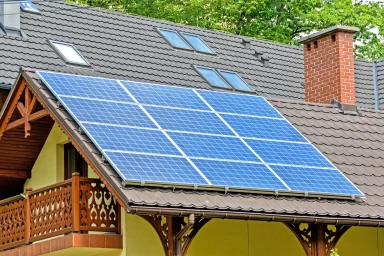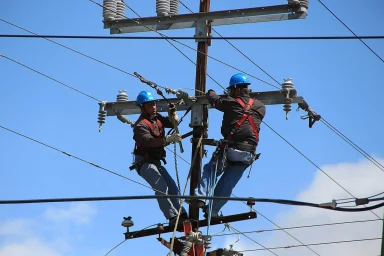
Owning a solar system is mostly watching, paperwork and a few planned bills. The Department of Energy puts a panel’s average working life at 25 to 35 years. The panels rarely fail; they make a little less power each year. The parts around them wear out sooner: the whole-house inverter warranties we read run 10 to 12 years, so plan on replacing an inverter at least once. Most rooftop panels don’t need cleaning, and most repairs aren’t the panels at all. The catch in almost every repair is labor, which maker warranties usually don’t pay.
This page takes the owner’s jobs in order, with the guide for each, then the small route: plug-in and balcony kits for people without a rooftop system, renters included.
This is general information, not professional, tax or legal advice. Leaf & Watt sells, installs, cleans and repairs nothing. Your warranty documents, your contract, your utility and a licensed electrician decide what applies to your system.
The owner’s jobs at a glance
| Job | When | Who |
|---|---|---|
| Check the monitoring app against the same month last year | Every month | You |
| Look for cracked glass, scorch marks, loose wiring or nests | Now and then, from the ground | You |
| Keep the system online and registered | Always; some warranties depend on it | You |
| Clean the panels | Usually never; rain does it in most of the US | You from the ground, or a professional |
| Fix a fault or swap a failed part | When monitoring shows one | The installer or a licensed electrician |
| Replace the inverter | Likely once while you own the panels | The installer or a licensed electrician |
| Take the panels off for a new roof | When the roof needs it | The installer, with any permit your city requires |
How long each part lasts
A solar system is several products with different lives. Panels fade slowly: an NREL review of field tests found a median loss of 0.5% a year, and a study of 387 home systems found 1.3%, faster on shaded roofs. Even at the higher rate, a system still makes about three-quarters of its first-year output in year 25.
The rest wears out sooner. Enphase’s microinverters carry 25-year warranties, but whole-house inverters carry 10 to 12 in the warranties we read: 10 for the one built into the Powerwall 3, 12 for most SolarEdge inverters. The home batteries we checked carry 10 to 15 years and promise only 60% to 70% of their capacity at the end. The year-by-year math, the warranty terms and the questions to ask before you sign are in our guide to how long solar panels, inverters and batteries last.
Two lessons follow for any estimate. A payback figure that assumes no yearly loss is too optimistic, so set a realistic one in our solar payback calculator. And panels that last 30 years can outlive the roof under them. Taking them off and putting them back for a new roof costs $200 to $300 a panel in Fixr’s published estimate, on top of the roof itself. The cheapest time to replace an ageing roof is just before the panels go on.
Watching it: the monitoring app
Compare each month with the same month last year, not with the month before, because winter and cloudy spells cut output with nothing wrong. A slow slide of under 1% a year is normal. A whole system at zero points to the inverter, a tripped breaker or the grid connection; one panel well below its neighbours points to a microinverter, an optimizer, wiring or shade. If the app says “not reporting” but your bill hasn’t changed, suspect the internet link, often a new router or Wi-Fi password.
Reconnect it promptly. SolarEdge’s warranty says it can’t be honored for a product that isn’t connected to its monitoring, other than in temporary outages. Tesla’s Powerwall warranty can drop to as little as 4 years after a lapse in connection or registration, and FranklinWH’s drops to 4 years after more than 90 days offline without reconnecting.
Cleaning: usually not needed
Rain keeps most rooftop panels clean enough. NLR’s PVWatts tool assumes a 2% yearly loss to dirt by default. On our worked examples, a $209 cleaning (Thumbtack’s typical national figure) would have to win back 9.7% to 12.7% of a year’s output in Phoenix, Raleigh and Houston, and 4.8% in Los Angeles, more than PVWatts’ whole default soiling loss. The exceptions are bird droppings, stuck leaves, sites downwind of a farm field or highway, and heavy pollen, which cut output at North Carolina solar farms by up to 15%.
If panels do need washing, read the maker’s manual first: Qcells says cleaning has to be done by qualified personnel, while REC allows a garden hose at household pressure. No pressure washer unless your manual allows it, no climbing on the roof, and no cool water on hot glass. Falls are the main danger; OSHA counts them among the most common causes of serious work-related injuries and deaths. Our guide to how to clean solar panels, and when not to has the break-even math, what three makers’ manuals allow, and what to ask a cleaner.
When something breaks
In a federal lab study of 100,000 US systems, inverters were the part reported to fail most often (4% to 6%), while module failures were rare (0.2%). Residential inverter problems took a median of 37 days to fix. In Angi’s published 2026 figures, most owners paid $238 to $1,494 for a repair, with an $866 average.
Who pays is the real question. The maker warranties we read replace a faulty part but don’t pay anyone to climb up and swap it. That falls to the installer’s workmanship warranty, a lease contract, your home insurance or you. The warranties we read exclude animal damage, and the panel warranty we read excludes hail, so chewed wiring is usually yours and storm damage is a question for your insurer. If your installer has closed, you can usually still claim the part from the maker directly and hire a licensed electrician for the labor. Our solar panel repair guide covers first checks from the ground, a worked repair estimate from BLS wages, what waiting costs in lost output, and what a repair quote should say.
The paperwork that saves money later
Keep the contract, the panel and inverter serial numbers, each maker’s warranty document, the permit and the utility’s permission-to-operate letter: claims and house sales both need them. Claim deadlines are short: 30 days from finding a defect for the Qcells panels we read, 90 days for Enphase microinverters. Some warranties pass to a buyer only with paperwork; Enphase needs a form and a fee within 30 days of the sale. With a lease or power purchase agreement, the provider owns the equipment and the contract says who fixes what. Selling a house with one raises its own questions, covered in our guide to buying or selling a house with leased solar panels.
The small route: plug-in and balcony solar
A plug-in kit is one to four panels and a microinverter that plug into an outlet and cover part of what the home uses while the sun shines. As of 4 November 2026, ten states have signed laws exempting these kits from the utility’s usual interconnection process: Utah, Maine, Colorado, Maryland, Connecticut, Vermont, Virginia, New Hampshire, California and New Jersey. Four start only in 2027. Most cap a kit at 1,200 W; Colorado allows 1,920 W, and Maine 420 W without an electrician. Every law we could read requires lab certification. A kit doesn’t keep the lights on in an outage, and Utah, Maine, Virginia and Maryland exclude these devices from net metering. Elsewhere, ask your utility in writing and don’t plug one in before it answers. Our plug-in solar guide to state laws, limits and safety sets out each law and how to check a kit’s certification.
Renters also need the landlord: only Virginia, Colorado and New Jersey limit a landlord’s right to say no, and Virginia’s and Colorado’s rules start on 1 January 2027. Everywhere else, get the landlord’s written yes. Our guide to balcony solar for renters and apartments explains what each state allows and what to put in the email.
The savings are small and depend on how much of the output your home uses as it is made. A 360 W kit hung on a south-facing railing in Denver makes about 397 kWh a year in our PVWatts run; at Colorado’s average rate it saves about $58 a year and pays back a $461 kit in about 8 years. A 1,200 W kit makes over three times the power but saves only about $31 a year more, because a home with a 164 W always-on load can’t use most of the midday surplus, and none of the laws we read require the utility to pay for it. Our plug-in solar calculator runs the math on your kit, your placement and your rate.
Where to go next
If you lease your system or are weighing a lease against buying, start with our lease, loan or cash guides. If you are thinking of adding storage to a system you already own, our batteries and backup guides cover sizing, prices and spec sheets.
Figures come from the guides linked above, cited in full at each claim. Cost figures are published estimates, not quotes. Rules differ by state and utility. Sources checked on 4 November 2026.