Battery backup for a home is about two numbers. Energy, in kWh, sets how long the battery lasts. Power, in kW, sets how much can run at the same moment. A 13.5 kWh battery, the median size paired with home solar in 2025 according to Lawrence Berkeley National Laboratory, would run the average US home for about 10 hours. Cut back to a refrigerator, lights, a TV, a microwave and the internet router and it lasts about two days. Solar panels can refill it during the outage, but only on days with sun. This guide shows the arithmetic behind those figures so you can redo it for your own house. It also covers what the battery can and can’t start, and what to check in a quote. It’s part of our batteries and backup guides.
Leaf & Watt sells and installs nothing and takes no referral fees. Product figures below come from the makers’ own datasheets and manuals. This page is general information, not professional, tax or legal advice.
The short answer
- Whole house, normal use: about 10 hours from one full 13.5 kWh battery. The average US home used 10,791 kWh in 2022 (EIA), about 29.6 kWh a day.
- Essentials only (refrigerator, lights, TV, microwave, router): about 2 days from the same battery, using the national average figures for each appliance worked through below.
- An electric water heater, electric heat or central air each uses more electricity in a year than all of those essentials combined, and heating and cooling pack theirs into a few months. These loads decide whether a battery lasts hours or days.
- The charge when the outage starts matters as much as the battery’s size. If the battery is sitting at a 20% backup reserve when the grid drops, a 13.5 kWh unit may have only about 5½ hours of essentials left.
- Solar recharging can stretch a battery across a multi-day outage. A national-lab model, with solar sized to the home’s yearly use, found it covered basic loads through a 3-day outage in almost every county and month when heating and cooling were left out, and less when they were included.
For your own numbers, our battery run time calculator takes your battery size and the loads you want to keep running.
kWh and kW: tank size and tap width
Think of the battery as a water tank. kWh is the size of the tank: how much energy it holds. kW is how wide the tap is: how much power it can deliver at once. A big tank with a narrow tap can keep a refrigerator running for days but can’t start a central air conditioner. A small tank with a wide tap can start the air conditioner but runs out quickly.
There is a third rating that matters for anything with a motor: starting current. Compressors and pumps draw several times their running current for a moment when they start. Appliance nameplates list this as LRA (locked rotor amps). Battery makers state it in different ways, and some don’t state it at all. Here is what the makers’ US datasheets say, read on 3 November 2026. This is a spec comparison, not a ranking.
| Battery (maker datasheet) | Usable energy | Continuous power | Motor starting |
|---|---|---|---|
| Tesla Powerwall 3 | 13.5 kWh (AC, nominal) | Up to 11.5 kW (5.8, 7.6 or 10 kW if set lower) | 185 LRA |
| Enphase IQ Battery 5P | 5.0 kWh | 3.84 kVA | Up to 48 A LRA |
| Enphase IQ Battery 10C | 10.0 kWh | 7.08 kVA | Up to 90 A LRA |
| FranklinWH aPower 2 | 15 kWh (AC) | 10 kW | 185 A LRA |
| Generac PWRcell 2 (M3 to M6) | 9 to 18 kWh | 5.2 to 10.5 kW | 65 to 130 A AC start |
Systems can usually be expanded. Tesla’s datasheet allows up to 4 Powerwall 3 units, each with its own inverter, so each adds both energy and power; up to 3 Powerwall 3 Expansion units add storage only (Powerwall 3 datasheet, linked in the table; Powerwall 3 Owner’s Manual, System Design). To check a motor load, find the LRA on the nameplate of your air conditioner’s outdoor unit or your well pump and compare it with the battery system’s rating. If the battery’s figure is lower, or the maker doesn’t give one, ask the installer in writing whether that appliance will start on battery. A soft-start device fitted to the compressor is one fix installers offer. Whether one suits your unit is a question for the installer and the equipment maker.
Tesla’s support page says that during an outage you can “back up any number of appliances” as long as their combined draw stays under the Powerwalls’ total power rating. Starting large loads can overload it and stop it powering the house. In that case, turn the large loads off and the battery tries to restart within a minute (Tesla, Best Practices During Power Outages).
What a battery runs, appliance by appliance
Runtime depends on energy per day, not on the wattage on a label. A refrigerator might draw a few hundred watts while its compressor runs, but it cycles on and off. The Department of Energy’s appliance guide says that to estimate how long a refrigerator actually runs at full wattage, you divide the time it is plugged in by three (DOE Energy Saver, archived 1 January 2026; the live page no longer loads). The most reliable national figures for daily energy are the averages in EIA’s Residential Energy Consumption Survey. It measured how much electricity each end use takes in a year in homes that have it (RECS 2020, Table CE5.3b, and Table CE5.3a, revised March 2024; the kWh figures are on the tables’ second sheet).
| End use (homes that have it) | kWh a year (EIA RECS 2020) | kWh a day (our arithmetic, ÷ 365) | Notes for backup |
|---|---|---|---|
| Most-used refrigerator | 617 | 1.69 | Runs all day; the compressor needs starting current |
| Separate freezer | 570 | 1.56 | A full freezer holds a safe temperature about 48 hours unpowered (below) |
| Lighting, all homes | 654 | 1.79 | Easy to cut during an outage |
| TVs and related devices | 632 | 1.73 | Includes cable boxes, consoles and streaming devices |
| Microwave | 107 | 0.29 | High wattage, but only for minutes |
| Air handler fan for heating | 233 | Seasonal | A gas or oil furnace still needs power for its fan and controls |
| Electric water heating | 2,706 | 7.41 | Uses more in a year than the refrigerator, lighting, TVs and microwave combined |
| Electric space heating | 2,484 | Seasonal | Concentrated in winter, so a cold day takes far more than the annual average suggests |
| Air conditioning | 2,318 | Seasonal | Concentrated in summer; the compressor needs starting current |
These are national averages. Your own appliances can use much more or much less. Two better sources: the yellow EnergyGuide label (kWh a year, divided by 365) and your utility’s hourly or daily usage data, which shows what the house actually uses at night and on hot or cold days. For heating and cooling, a year’s figure spread over 365 days hides the real problem: the energy all lands in a few months, and most of it on the coldest or hottest days.
Some loads are worth planning for even if they use little energy. A well pump means no water without power. A sump pump matters most in the storms that cause outages. Medical equipment comes first: Ready.gov advises asking your medical provider for a power outage plan for powered medical devices and having other plans for keeping medicines cold (Ready.gov, Power Outages, updated 4 June 2026). A battery can be part of that plan, but it shouldn’t be the only part.
How long it lasts: worked examples
The formula is short:
Hours of backup = energy available before shutdown (kWh) ÷ average load (kW)
“Energy available before shutdown” is less than the rated capacity. Tesla says that if a Powerwall has less than 10% of its energy left during an outage, it enters a standby state and stops powering the home (same Tesla page). So a full 13.5 kWh Powerwall 3 can supply about 13.5 × 0.90 = 12.15 kWh before it shuts down. Other makers handle this differently. Enphase’s datasheet says its usable-capacity figure includes a 2% safety limit kept for long outages, and that a further 3% is kept to run the battery’s electronics at night (IQ Battery 5P datasheet, linked in the table above). Check your own battery’s manual. The examples below use a 13.5 kWh battery that stops at 10%, starting full:
| What stays on | kWh a day | Average load | Runtime on 12.15 kWh |
|---|---|---|---|
| The average US home, everything as normal | 29.56 | 1.23 kW | About 10 hours |
| Essentials: refrigerator, lights, TV and devices, microwave, router | 5.87 | 0.24 kW | About 50 hours (2.1 days) |
| Essentials plus a separate freezer | 7.43 | 0.31 kW | About 39 hours (1.6 days) |
| Essentials, freezer and an electric water heater | 14.84 | 0.62 kW | About 20 hours |
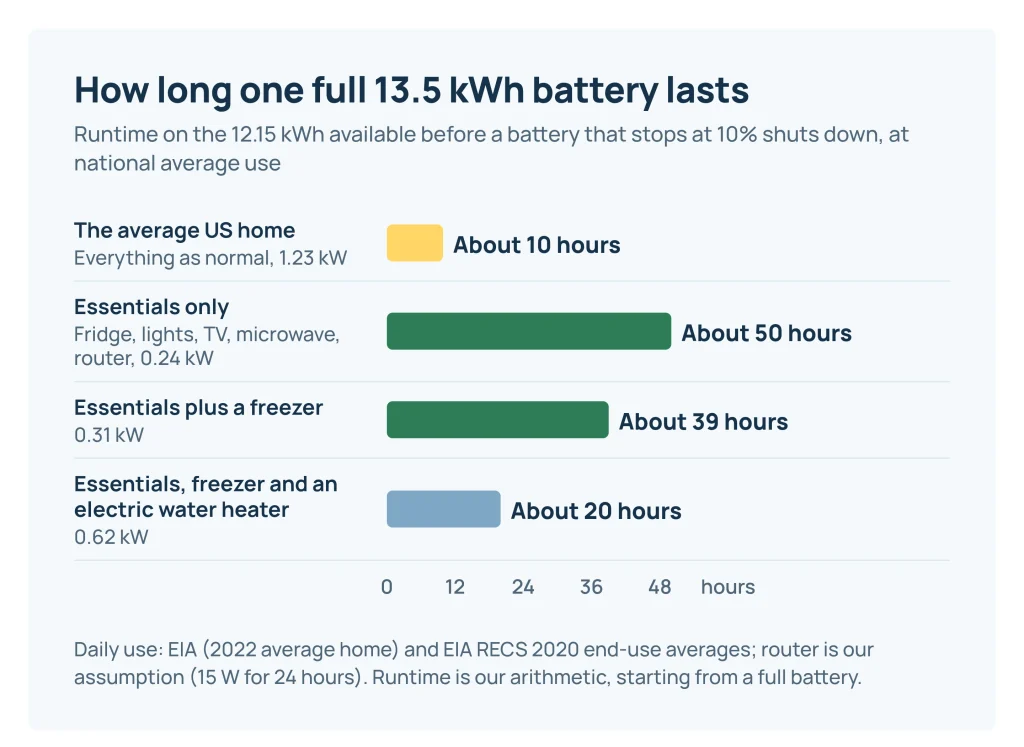
Here’s the arithmetic. The average home: 10,791 kWh ÷ 365 = 29.56 kWh a day, or 1.23 kW on average, so 12.15 ÷ 1.23 = 9.9 hours. The essentials use the RECS figures in the table above (1.69 + 1.79 + 1.73 + 0.29 kWh a day) plus 0.36 kWh for an internet router and modem. That router figure is our assumption, a 15-watt load running 24 hours. Total: 5.87 kWh a day, so 12.15 ÷ 5.87 = 2.07 days. Adding the freezer’s 1.56 brings it to 7.43 kWh a day and 1.64 days. Adding the water heater’s 7.41 brings it to 14.84 kWh a day and 0.82 days, about 20 hours. Two 13.5 kWh batteries double the energy, so the average home would get about 20 hours.
For comparison, FoodSafety.gov says a refrigerator keeps food safe for up to 4 hours in a power outage (keep the door closed as much as possible), and a full freezer holds a safe temperature for about 48 hours, or 24 hours if it is half full and the door stays closed (FoodSafety.gov, reviewed 8 August 2024). So in an outage the refrigerator needs the battery more than the freezer does. Most years bring only a few hours without power in total. In 2025, the average US customer was without power for 262.6 minutes over the year including major events (about 4.4 hours), or 120.8 minutes without them (EIA Electric Power Annual, Table 11.3, released 21 October 2026). In 2024, a heavy hurricane year, the average was about 11 hours (EIA Today in Energy, 1 December 2025). Those are averages over a year, not the length of any one outage, so sizing comes down to how long an outage you want to ride out.
Your starting charge matters as much as size
Most home batteries also do daily work, such as storing midday solar for the evening or avoiding peak time-of-use rates. That means they are often partly empty when the grid goes down. The backup reserve setting is the share of charge the battery keeps back for outages. Tesla’s app allows any reserve between 0% and 80%, shows a “Low Backup Reserve” warning below 20%, and offers a mode that holds the battery at 100% for up to 72 hours. If an outage starts while the battery is below 5%, the house loses power straight away, and the battery waits to recharge from solar the next morning (Tesla, Backup Reserve). Tesla’s Storm Watch feature also prepares the battery for a possible outage during some extreme weather events (Tesla, Best Practices During Power Outages).
Here’s what that means for the essentials load above (0.24 kW), on a 13.5 kWh battery that stops at 10%, if the outage begins with the battery sitting at its reserve:
| Charge when the outage starts | Energy before shutdown | Essentials runtime |
|---|---|---|
| 20% | 1.35 kWh | About 5.5 hours |
| 30% | 2.70 kWh | About 11 hours |
| 50% | 5.40 kWh | About 22 hours |
| 80% (Tesla’s highest reserve setting) | 9.45 kWh | About 39 hours |
| 100% (storm or full-backup mode) | 12.15 kWh | About 50 hours |
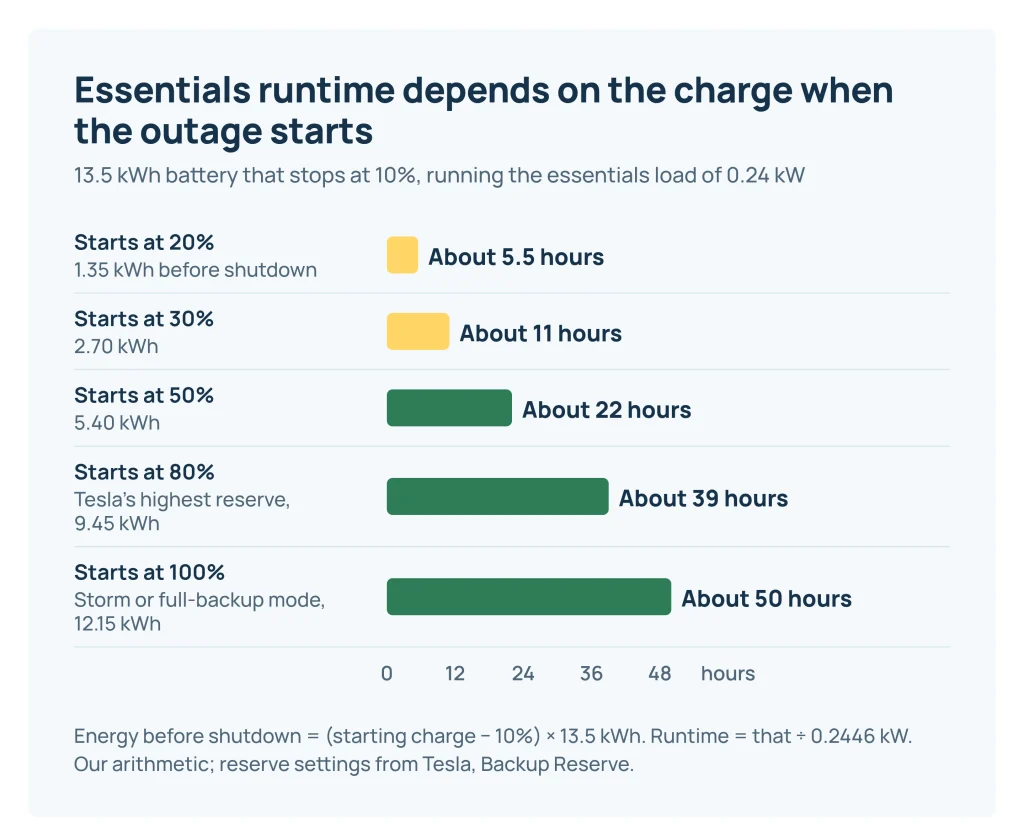
Energy before shutdown is (starting charge − 10%) × 13.5 kWh. Runtime is that figure divided by 0.2446 kW (5.87 kWh ÷ 24 hours). These are floors, not forecasts: on a sunny afternoon the battery may be well above its reserve. A higher reserve leaves less of the battery for bill savings, and if the battery is enrolled in a utility program, that program’s terms may limit the choice.
Solar during an outage
Ordinary grid-tied solar with no battery shuts off in an outage. Tesla’s outage page says it “does not function during a grid outage”. With a battery and the right switching equipment, the panels can keep powering the house during the day and refill the battery. Tesla says its system turns the solar down once the battery is nearly full and the house can’t use the extra. If the battery has dropped into standby, it tries to recharge from solar every hour between 8 AM and 4 PM.
How much solar refills depends on the season and on the sky. As an example, take a 7 kW system (our example size) facing south at a 20° tilt. NLR’s PVWatts calculator (v8) estimates these averages per day, from runs on 3 November 2026 using typical-year weather and 14% system losses:
| City, 7 kW example | Average day over the year | Average December day |
|---|---|---|
| Houston | 27.2 kWh | 19.4 kWh |
| Boston | 25.0 kWh | 13.3 kWh |
| Seattle | 20.8 kWh | 7.5 kWh |
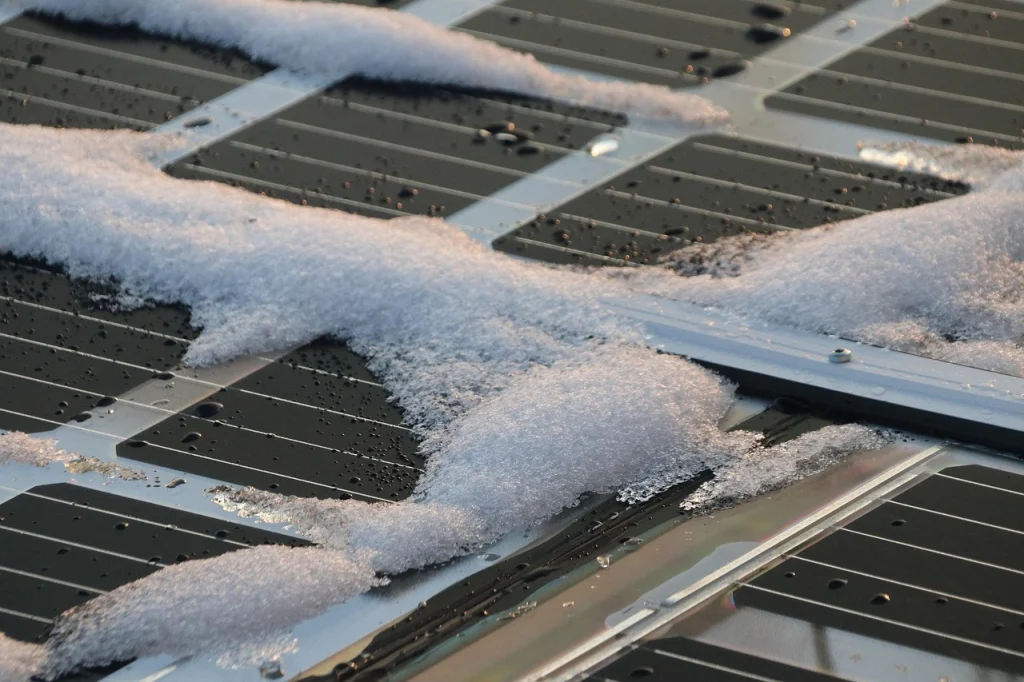
To get those figures, we multiplied PVWatts’ kWh per kW of panels (Houston 1,420 a year and 86 in December, Boston 1,301 and 59, Seattle 1,087 and 33) by 7, then divided by 365 or 31 days. A storm day can produce much less than any average. Snow or leaves on the panels cut output further, and Tesla advises checking panels daily in poor weather and clearing obstructions safely. In practice, that means from the ground. Leave roof work to a professional.
The most thorough public evidence on long outages comes from a September 2022 study by Lawrence Berkeley National Laboratory and NREL (Gorman et al., narrative summary). It simulated solar plus storage in every US county, with the solar sized to cover the home’s whole year of use. Its main results for single-family homes:
- With only refrigeration, night-time lights, computer and internet, and well pump on backup (no heating or cooling), 10 kWh of storage could fully cover a 3-day outage in “virtually all” counties, in any month.
- Add heating and cooling and the 10 kWh system covered 86% of the critical load on average, and a 30 kWh system 96%.
- Performance was lowest where electric heating is common (the Southeast and Northwest) and where cooling loads are large. In counties with a lot of electric heat, outages starting on the worst winter days were 53% covered, against 96% on the best days.
- In a sample of homes in Harris County, Texas, with 30 kWh of storage, homes with electric resistance heat had a median of 77% of winter critical load met, against 96% with heat pumps and 100% with fossil-fuel heating.
- In historical events from 2017 to 2020, most homes with 30 kWh would have kept critical loads running in 7 of 10 events. Hurricane Florence was the weakest case, with almost no solar production for the first three days of an outage of about 8 days.
The authors note their model ignores snow on panels and storm damage, and assumes people keep normal thermostat settings. A household that turns the thermostat down or heats only one room would do better than the model. Real outages can also be worse than the typical weather it used.
Without solar, the battery charges only from the grid. Once it’s empty, it stays empty until the grid comes back. Tesla says that if a restart fails, you will need to wait for a grid connection. For that setup, see home battery backup without solar.
Whole-home or partial backup
There are two ways to set up backup, and Tesla’s owner’s manual (System Design page, linked above) describes both. In partial backup, the backed-up loads “are selected during the system design phase” and the installer configures the system to leave everything else off backup. The rest of the house stays dark, so you can’t drain the battery with the dryer by accident. In whole-home backup, the system powers the entire home during an outage.
Whole-home backup is more convenient, but you have to manage loads yourself during an outage. Tesla’s advice is to cut back on air conditioners, vehicle charging, electric heaters and dishwashers. Some systems can also switch off large circuits automatically, through the maker’s own load controllers or a smart panel. If you want that, ask the installer which circuits it can switch and how. Our guide to whole-home battery backup covers sizing for that case.
Either way, this is electrician work, done under a permit and the utility’s interconnection rules. Never connect a battery or a portable power station to house wiring through an outlet. That can send power back into the lines. The CDC warns that backfeed “can seriously injure or kill repair workers or people in neighboring buildings” (CDC, Worker Safety in a Power Outage, archived page). A plug-in power station runs only what is plugged into it, unless a licensed electrician has installed a transfer switch made for it.
Cold, heat and warranty conditions
- Temperature. Powerwall 3 is rated to operate from −4°F to 122°F and may limit charging or discharging at the extremes, with output possibly reduced above 104°F (owner’s manual, Care and Maintenance). Enphase’s IQ Battery 5P datasheet gives full charging performance from 59°F to 113°F and full discharging from 32°F to 122°F. Outside those ranges the current is reduced. So a battery in an unheated garage may refill more slowly from winter sun.
- Staying online. Some warranties depend on an internet connection. Tesla’s Powerwall warranty (Rev 2.6, 6 May 2026) says a lapse in internet connection or registration can cut cover to as little as 4 years. FranklinWH’s says that if the system stays disconnected from the internet for more than 90 consecutive days and isn’t reconnected after a notice, the warranty drops to 4 years (FranklinWH warranty, effective 28 October 2026). If you plan to use a battery only for backup and rarely open the app, read this clause first.
- Flooding. Tesla’s manual says to stay out of the water if any part of the battery, gateway or wiring is under water, and to contact support before turning it back on (What to Do in Case of an Emergency).
What backup costs, and the credit that ended
Published estimates differ in what they measure. EnergySage, a commercial quote marketplace, puts a typical installed battery at $15,647 for 13.5 kWh before incentives, based on quotes from the first half of 2026 (EnergySage, updated 13 July 2026). NREL’s bottom-up model for 2023 put an 8 kW solar system at $21,440, or $37,600 with a 5 kW, 12.5 kWh battery, in 2022 dollars. By our arithmetic, the battery adds about $16,160 (NREL/TP-7A40-87303). Lawrence Berkeley National Laboratory found that cash-purchase solar-plus-storage systems installed in 2025 had a median price $2.1 per watt of solar higher than solar alone, with about 80% of that price data from California (LBNL, 2026 data update). Our solar battery cost guide sets these side by side.
The electricity is cheap by comparison. Refilling 13.5 kWh from the grid at the US average residential price for January to August 2026, 18.19 cents per kWh (EIA Electric Power Monthly, Table 5.6.B, released 23 October 2026), comes to about $2.46, before charging losses. Your own rate may be quite different.
The 30% federal credit for homeowners no longer applies. Under 26 USC 25D(h), the credit does not apply to expenditures made after 31 December 2025, and an expenditure counts as made when installation is completed (26 USC 25D; IRS FS-2025-05). A battery bought with cash or a loan and installed in 2026 gets no federal homeowner credit. Lease and PPA providers may still be able to claim the business credit under 48E on batteries of at least 5 kWh. That is the provider’s credit, not yours, and how much of it reaches your price is up to the contract. See what ended and what’s left of the solar tax credit, and ask a tax professional about your own case. State and utility battery programs are separate and change often.
Safety and placement
- Listing. Building departments can require a home battery system to be listed to UL 9540, the safety standard for energy storage systems; the Washington tip sheet below does. UL 9540A is a fire-propagation test method, not a listing (UL Solutions). Ask for the listing in writing.
- Location. Where a battery may go is decided by your local building department and the maker’s installation manual. As one example, eastside Washington building departments summarize the 2021 IRC, with Washington amendments, as keeping batteries out of sleeping rooms and out of closets or spaces that open directly into them, and as allowing garages, utility spaces and exterior walls with stated limits (MyBuildingPermit tip sheet). Other places can differ.
- If something seems wrong. Tesla’s manual says to call the fire department first if there is any threat to health or safety and get everyone out, and to turn the system off only if that is safe. A city fire department in California tells owners that if a battery is unusually hot or makes strange noises, they should “turn off the system and contact a professional immediately” (Woodland Fire Department). The NFPA’s fact sheet warns that a battery fire can reignite “hours, days, or even weeks later” (NFPA ESS fact sheet).
- Upkeep. Tesla says Powerwall 3 needs no scheduled maintenance beyond keeping the area and air vents clear of debris.
If you are weighing a battery against a generator, our battery backup vs generator calculator compares the cost per outage. If you use a generator instead, the CDC says never to run one inside a home, basement or garage, or less than 20 feet from any window, door or vent (CDC).
What a backup quote should say
- Whole-home or partial backup, and a list of every circuit that stays on in an outage.
- Usable kWh, continuous kW and motor-starting rating of the whole system as installed, not one unit.
- For each motor load you care about (air conditioner, heat pump, well pump), whether it will start on battery, and whether a soft starter is included.
- Whether solar keeps working and recharges the battery when the grid is down, and what extra equipment that needs.
- The backup reserve the installer will set, and whether any utility program you join limits it.
- Where the battery goes, the UL 9540 listing, the permit, and who handles the utility’s interconnection agreement.
- Warranty terms in writing, including any internet-connection condition and the capacity guaranteed at the end.
- The price before any incentive, and who claims any credit or rebate. On a lease or PPA, that’s the provider.
Comparing models? Our Powerwall alternatives by spec sheet lines up the main batteries on their datasheet figures.
Sources checked on 4 November 2026. Product specifications come from the makers’ current US datasheets and manuals; makers revise them, so check the version your installer quotes. Runtimes on this page are estimates from national averages; your appliances, weather and settings decide the real figure. This is general information, not professional, tax or legal advice.
Sources
- EIA: How much electricity does an American home use? (FAQ, updated 8 January 2024, 2022 data)
- EIA: 2020 Residential Energy Consumption Survey, Table CE5.3b, end-use consumption averages (revised March 2024)
- EIA: 2020 Residential Energy Consumption Survey, Table CE5.3a, end-use consumption averages (revised March 2024)
- DOE Energy Saver: Estimating Appliance and Home Electronic Energy Use (archived 1 January 2026)
- Tesla: Powerwall 3 datasheet
- Tesla: Powerwall 3 Owner's Manual, System Design
- Tesla: Powerwall 3 Owner's Manual, Care and Maintenance
- Tesla: Powerwall 3 Owner's Manual, What to Do in Case of an Emergency
- Tesla Support: Best Practices During Power Outages
- Tesla Support: Backup Reserve
- Tesla: Powerwall limited warranty, Rev 2.6 (6 May 2026)
- Enphase: IQ Battery 5P datasheet
- Enphase: IQ Battery 10C datasheet (DSH-00565-10.0)
- FranklinWH: aPower 2 datasheet
- FranklinWH: limited warranty for end users (effective 28 October 2026)
- Generac: PWRcell 2 spec sheet (Rev C, January 2026)
- Lawrence Berkeley National Laboratory and NREL: Evaluating the Capabilities of Behind-the-Meter Solar-plus-Storage for Providing Backup Power during Long-Duration Power Interruptions, narrative summary (September 2022)
- Lawrence Berkeley National Laboratory: U.S. Distributed Solar and Storage, 2026 Data Update (August 2026)
- NLR: PVWatts Calculator (v8)
- NREL: U.S. Solar Photovoltaic System and Energy Storage Cost Benchmarks, Q1 2023 (NREL/TP-7A40-87303)
- EnergySage: How much do batteries cost? (updated 13 July 2026; commercial quote marketplace)
- EIA: Electric Power Monthly, Table 5.6.B (released 23 October 2026)
- EIA: Electric Power Annual, Table 11.3, reliability metrics (released 21 October 2026)
- EIA Today in Energy: power outage hours in 2024 (1 December 2025)
- FoodSafety.gov: Food Safety During Power Outage (reviewed 8 August 2024)
- Ready.gov: Power Outages (updated 4 June 2026)
- 26 USC 25D, Residential clean energy credit (Cornell LII)
- IRS FS-2025-05: FAQs for modification of sections 25C, 25D and others under Public Law 119-21
- UL Solutions: Energy storage system testing and certification
- MyBuildingPermit (eastside Washington building departments): Tip Sheet 26, Energy Storage Systems
- City of Woodland Fire Department: Residential Energy Storage Systems
- NFPA: Energy Storage Systems Safety Fact Sheet (February 2024)
- CDC: Worker Safety in a Power Outage (archived page, last reviewed 18 August 2004)
- CDC: What to do to protect yourself during a power outage (reviewed 26 August 2026)