A home battery has two sizes, and you need both. Energy, in kWh, decides how long it lasts. Power, in kW, decides how much it can run at once, and whether it can start your air conditioner or well pump at all. Our example house keeps the fridge, lights, internet and microwave going and runs a 3-ton air conditioner for 4 hours. Over a 24-hour outage it needs about 19 kWh of usable capacity when new and 27 kWh if the battery should still cover that at its warranty floor. It also needs 4.4 kW of continuous power and about 89 amps of starting current. Many online calculators stop at the energy figure. This one checks energy, power and starting current against the battery on your quote. For backup basics, start at our batteries and backup hub.
Typical sizes at a glance
These rows use the calculator’s defaults. They assume a 24-hour outage, a 10% margin and a battery that has aged to 70% of its capacity, the end-of-warranty floor in Tesla’s Powerwall warranty. They are examples, not recommendations.
| What you back up for 24 hours | Energy per day | Usable kWh, new | Usable kWh at 70% | Continuous power |
|---|---|---|---|---|
| Essentials: fridge, lights, TV and internet, microwave | 5.5 kWh | 6.1 | 8.6 | 1.5 kW |
| Essentials plus a 3-ton AC for 4 hours | 17.2 kWh | 18.9 | 27.0 | 4.4 kW |
| A whole average US home | 29.6 kWh | 32.5 | 46.4 | Depends on what runs at once |
For scale, the median battery paired with new home solar in 2025 was 13.5 kWh, mostly from California data, according to Lawrence Berkeley National Laboratory’s 2026 data update. That covers essentials for more than a day. It does not cover a whole average home: the average residential customer bought 899 kWh a month in 2022 (EIA), about 29.6 kWh a day. Our guide to whole-home battery backup covers that case.
How the calculator works
Each step is simple arithmetic. Every input can be edited.
- Daily energy. Add the kWh per day of each load. For anything with a wattage, use watts × hours a day ÷ 1,000, the method in Virginia Tech Extension’s appliance guide.
- Outage energy. Daily energy × hours of backup ÷ 24.
- Usable capacity, new. Add any daily kWh you also want the battery to shift on a time-of-use rate, then add the margin: (outage + shift) × (1 + margin).
- At the warranty floor. Divide by the share of capacity the warranty guarantees at its end, 70% by default.
- Continuous power. The running watts of your largest motor load plus everything else that may run with it, ÷ 1,000.
- Starting current. The motor’s locked rotor amps (LRA) from its nameplate, plus the other loads’ current at 240 volts (watts ÷ 240, a simplification).
- Batteries needed. Divide each need by one battery’s rating and round up. The count to plan for is the largest of the energy-at-the-floor, power and starting counts.
The calculator uses the usable kWh printed on the datasheet. It does not apply a separate “depth of discharge”. Some online calculators divide by a depth of discharge. If the figure you’re comparing is already the usable one, that counts the same loss twice and oversizes the battery. If a quote lists only a “total” or “nominal” capacity, ask for the usable figure. Makers word this differently. Enphase prints both, 10.0 kWh total and 10.0 kWh usable, for the IQ Battery 10C. FranklinWH lists 15 kWh AC as usable energy. Tesla lists Powerwall 3’s 13.5 kWh AC as “nominal battery energy”, and its warranty promises 13.5 kWh of energy capacity at installation.
Worked example
This example uses the calculator’s defaults: a house with gas heat and a 3-ton central air conditioner, in a summer outage, sized against a battery with the specs of a Tesla Powerwall 3.
| Step | Working | Result |
|---|---|---|
| Small loads per day | Fridge 1.7 + lights 1.8 + TV and internet 1.7 + microwave 0.3 | 5.5 kWh |
| Air conditioner per day | 2,923 W × 4 h ÷ 1,000 | 11.7 kWh |
| Daily energy | 5.5 + 11.692 | 17.2 kWh |
| Outage energy | 17.192 × 24 ÷ 24 | 17.2 kWh |
| Usable capacity, new | 17.192 × 1.10 | 18.9 kWh |
| At the 70% warranty floor | 18.911 ÷ 0.70 | 27.0 kWh |
| Continuous power | (2,923 + 1,500) ÷ 1,000 | 4.42 kW |
| Starting current | 83 + 1,500 ÷ 240 | 89.3 A |
| 13.5 kWh batteries for energy | 18.911 ÷ 13.5 = 1.40 new; 27.016 ÷ 13.5 = 2.001 at the floor | 2 new, 3 at the floor |
| 11.5 kW batteries for power | 4.42 ÷ 11.5 = 0.38 | 1 |
| 185 A batteries for starting | 89.3 ÷ 185 = 0.48 | 1 |
| Hours one battery runs these loads | 13.5 ÷ (17.192 ÷ 24) | 18.8 h |
Energy, not power, sets the size here. Two batteries cover the outage when new. At the floor, 27.0 kWh is just over two batteries’ worth, so the strict answer is three. In practice, cut the air conditioner from 4 hours to 3.5, or the margin from 10% to 9%, and two batteries are enough even at the floor. That is a choice to make knowingly, with the numbers in front of you. Without the air conditioner, one 13.5 kWh battery covers the essentials for about 59 hours.
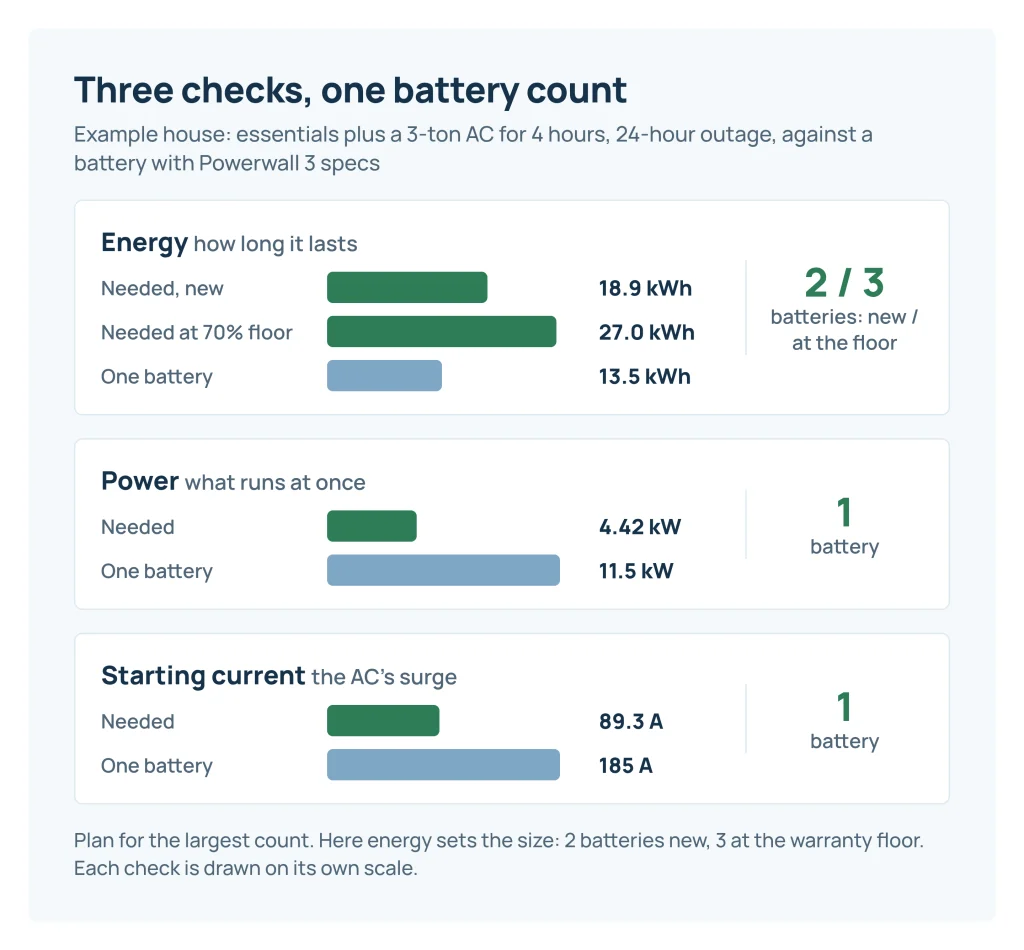
Now try the same house with smaller modular units: 5 kWh usable, 3.84 kVA continuous (entered as 3.84 kW) and up to 48 A LRA each, the specs of an Enphase IQ Battery 5P. Energy needs 4 units new and 6 at the floor. Power needs 2 (4.42 ÷ 3.84 = 1.15). Starting needs 2 (89.3 ÷ 48 = 1.86). With small units, power and starting current can set the minimum count before energy does.
Step 1: what your loads use per day
The defaults are national averages from EIA’s 2020 Residential Energy Consumption Survey, tables CE5.3a and CE5.3b (revised March 2024). Each is the yearly kWh for homes that have that load, divided by 365, so it is a whole-year average. Your own appliances can be far from it.
| Load | EIA 2020 average, kWh a year | Per day | Better: your own figure |
|---|---|---|---|
| Main refrigerator | 617 | 1.7 | Yearly kWh on the yellow EnergyGuide label ÷ 365 |
| Separate freezer | 570 | 1.6 | Its EnergyGuide label |
| Lighting | 654 | 1.8 | Watts of the bulbs you’d use × hours |
| TVs and related devices | 632 | 1.7 | Add the router, laptops and phone chargers |
| Microwave | 107 | 0.3 | Its watts × hours used |
| Air conditioning, all types (fans in the indoor unit are counted separately) | 2,318 | Season-dependent | Running watts × hours it runs |

For anything not in the list, use the “anything else” input. A furnace blower, well pump or sump pump is watts × hours a day ÷ 1,000. Look for the watts on the nameplate. If the nameplate gives only amps, multiply by its voltage (120 or 240) for a rough figure. Virginia Tech’s guide lists a deep-well pump at 250 to 1,100 W. Your pump’s own label is better than any table.
To estimate cooling, the calculator divides an air conditioner’s capacity by its efficiency. Rheem’s RA14AZ spec sheet rates the 3-ton RA14AZ36, with its listed indoor coil, at 34,200 Btu/h and 11.7 EER2. EER is Btu/h per watt, so that is about 2,923 W at the rating conditions. Hours are harder. A compressor cycles on and off, and on a very hot afternoon it may barely stop. The 4 hours in the default is our assumption. If you have a smart meter, your utility’s hourly data from a hot day shows what the house really used.
Step 2: power and starting current
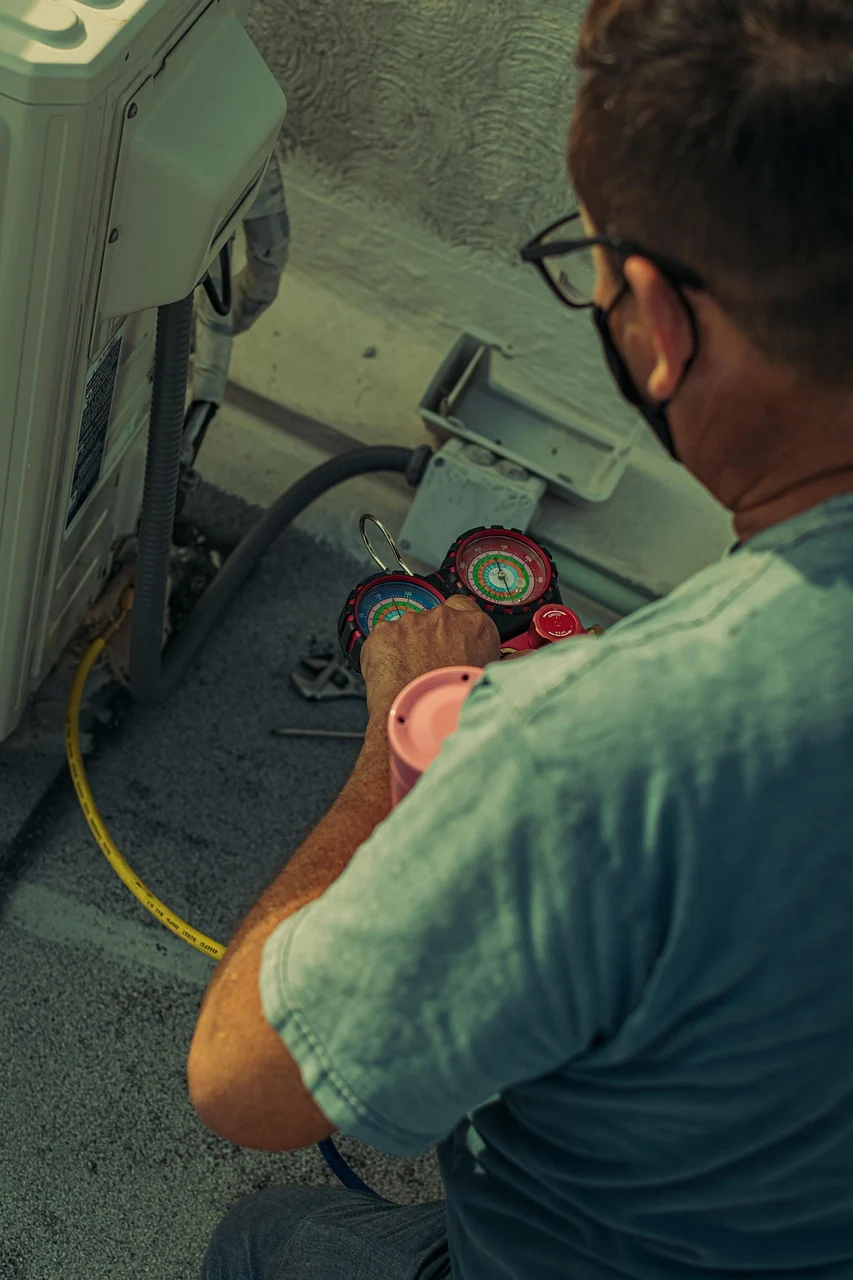
A battery big enough in kWh can still fail the moment the air conditioner kicks on. Motors draw a surge for a fraction of a second when they start. On the nameplate this surge is the locked rotor amps, or LRA. Enphase’s white paper on starting HVAC loads says the LRA “can be five times or larger” than the running current. It also says the battery must cover the LRA plus whatever else is running when the compressor starts. That is the sum the calculator makes.
The same white paper prints typical LRA ranges by air conditioner size, from “top HVAC manufacturers”. These are a battery maker’s figures, not a standard, and your unit’s nameplate decides:
| AC size | Typical LRA (Enphase table) | Rheem RA14AZ compressor LRA (spec sheet) |
|---|---|---|
| 2 ton | 35 to 65 A | 60 A |
| 3 ton | 70 to 85 A | 83 A |
| 4 ton | 83 to 130 A | 102 A |
| 5 ton | 110 to 153 A | 150 A |
Each maker states its battery’s starting ability on its own datasheet. They don’t all use the same terms, so compare like with like. These are specs from each maker’s own documents, read on 4 November 2026. This is not a ranking:
| Battery (datasheet) | Energy per unit | Continuous power | Motor-start rating | Capacity at end of warranty |
|---|---|---|---|---|
| Tesla Powerwall 3 | 13.5 kWh AC (listed as nominal battery energy) | Up to 11.5 kW (also 5.8, 7.6, 10) | 185 LRA | 70% at 10 years |
| Enphase IQ Battery 5P | 5.0 kWh | 3.84 kVA | Up to 48 A LRA | Over 60%; up to 15 years or 6,000 cycles |
| Enphase IQ Battery 10C | 10.0 kWh | 7.08 kVA | Up to 90 A LRA | 60%; up to 15 years or 6,000 cycles |
| FranklinWH aPower 2 | 15 kWh AC | 10 kW / 11.5 kVA | 185 A LRA | 70% at 15 years or 60 MWh |
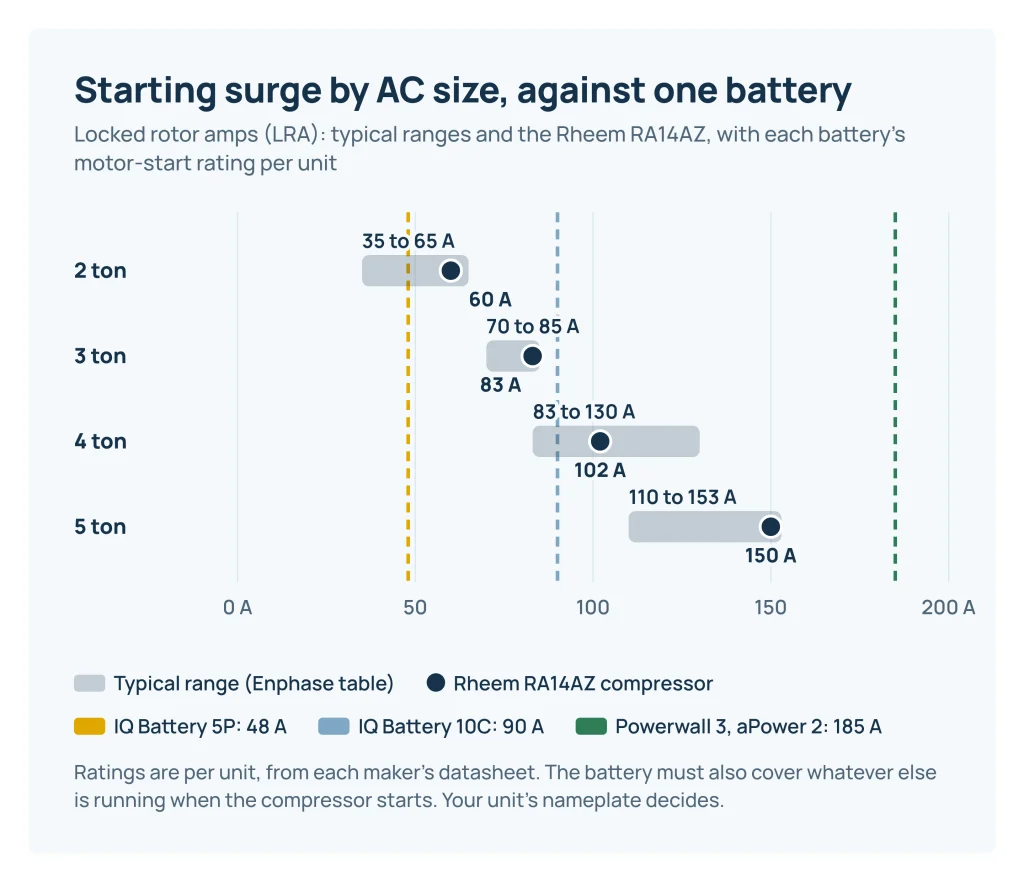
The battery counts assume each unit adds its full rating, and that’s not always true. Enphase says the 5P’s starting capability “is additive per battery”. Its tests found one 5P could not start a 3-ton unit with a 75 A LRA, and two could. Tesla’s datasheet lists more Powerwall 3 units (up to 4) under power scalability, and Expansion units (up to 3) under energy scalability only. So if a Tesla quote adds Expansions, the kW and LRA stay those of the Powerwall 3 units. More products, compared on their datasheets, are in our page on Powerwall alternatives.
If the starting current is short, there are two usual fixes: more battery units, or a soft starter on the compressor. A soft starter is a device that reduces the starting surge. Whether one suits your unit, and what it does to the warranty, is a question for your HVAC contractor and the battery installer. We have not seen a primary source for how much any model reduces LRA.
Ageing: why the warranty floor matters
Batteries lose capacity as they age. Warranties promise a floor, not today’s figure. Tesla guarantees 70% of Powerwall 3’s capacity at 10 years. FranklinWH guarantees 70% at 15 years or 60 MWh of throughput, whichever comes first. Enphase guarantees at least 60% for the IQ Battery 5P and 10C, over up to 15 years or 6,000 cycles. A Powerwall 3 sized exactly for today’s needs may hold only 70% of that by year 10 and still be within its warranty.
The calculator shows both numbers. Use the new figure if the battery is mainly for short outages, or if you could add a unit later. Use the floor figure if a load such as a sump or well pump must run for the full outage in year 10. Warranties also have conditions. Tesla says that if a Powerwall is off the internet for an extended period or isn’t registered, it may not be able to honor the full ten years, but will always honor at least four. FranklinWH’s becomes a four-year warranty if the system stays offline for more than 90 consecutive days and isn’t reconnected after FranklinWH’s notice, or if it isn’t registered at installation. Read the terms on your quote.
Don’t size a home battery as the backup for life-support or other medical equipment. The Tesla, Enphase and FranklinWH warranties all say their batteries are not intended as a primary or backup power source for those uses. If someone in the house depends on powered medical equipment, ask the equipment supplier and your doctor what backup it needs, and tell your utility.
Backup plus daily use
Many owners also use the battery every evening on a time-of-use rate. A battery that has just finished an evening of shifting won’t be full when the power goes out. If you want both, enter the kWh you want to shift each day. The calculator adds them on top of the outage energy. It also shows the share of charge to hold back for outages, which battery apps usually call a reserve. With 10 kWh of shifting, the example needs 29.9 kWh new, and 63% of it is held for backup. Whether shifting pays depends on your tariff. Our time-of-use battery savings calculator works that out.
Where solar fits
The calculator sizes the battery as if no sun arrives. That is deliberate. Outages often come with storms, and solar output on a dark day can be a small fraction of the average. NLR’s PVWatts (v8) estimates, for example, about 1,420 kWh a year per kW of panels in Houston, or 3.9 kWh a day on average (south-facing, 20° tilt, 14% losses; run 3 November 2026). Treat any solar recharge during an outage as a bonus, not as part of the size. Ask your installer whether your panels will charge the battery while the grid is down; that depends on how the system is designed and wired.
What each kWh costs
Every extra kWh adds to the quote. These are published estimates from EnergySage, a commercial quote marketplace: averages of the quotes on its platform in the first half of 2026, before incentives (EnergySage, updated 13 July 2026):
| EnergySage figure | Value |
|---|---|
| Typical system, 13.5 kWh | $15,647 |
| Tesla average | $967 per kWh |
| FranklinWH average | $1,232 per kWh |
| Enphase average | $1,429 per kWh |
| State averages | $563 (Alabama) to $1,586 (Louisiana) per kWh |
The federal homeowner credit no longer helps. Under 26 USC 25D(h), it does not apply to expenditures made after 31 December 2025, and 25D(e)(8) treats an expenditure as made when the installation is completed. Batteries were covered, so a battery installed in 2026 gets no 25D credit. Our page on the solar tax credit in 2026 explains what is left, and our solar battery cost guide breaks down a quote.
What to ask before you sign
- Which circuits are backed up? Ask for the list in writing. Your sizing is only as good as this list.
- Usable kWh, not total. Ask for it per unit and for the system.
- Continuous kW at the setting installed. Powerwall 3, for example, can be set to 5.8, 7.6, 10 or 11.5 kW.
- Can it start your largest motor? Give the installer the LRA from the nameplate. Ask how they checked it, and whether a soft starter is planned.
- The warranty floor and its conditions: years, throughput or cycles, end capacity, and what happens if the system goes offline.
- Can more units be added later? Ask for the maximum, and whether new units add energy only or power as well.
- Permits and placement. Codes limit where batteries go and how many kWh can sit in one space. The 2021 IRC with Washington amendments, as reproduced by one group of Washington building departments, limits each unit to 20 kWh. It caps the total at 40 kWh in utility closets, basements and storage or utility spaces, and at 80 kWh in garages, accessory structures, on exterior walls and outdoors, unless the battery’s UL 9540A test report supports more. It bars batteries from sleeping rooms and from closets or spaces opening directly into them. Three 13.5 kWh units total 40.5 kWh, just over that indoor figure. Your local building department decides what applies to you.
What this calculator can’t tell you
It gives estimates from the figures you enter. It doesn’t know your panel, your wiring, your installer’s settings or your tariff. Cold weather, an older battery and loads you forgot can each leave you short. That is why there is a margin, and why you should test your backup plan before you need it. The counts assume all of a battery’s rated power is available to your backed-up loads.
Battery, inverter and panel wiring is work for a licensed electrician, with a permit and the utility’s approval to connect. The NFPA’s fact sheet warns that lithium-ion batteries can go into thermal runaway, release toxic and flammable gases, and reignite hours to weeks after a fire. Woodland (California) Fire Department advises that if a battery is unusually hot or makes strange noises, you should “turn off the system and contact a professional immediately”.
Leaf & Watt sells and installs nothing and takes no referral fees. Products named here are examples from their makers’ datasheets, not recommendations. This page is general information, not professional, tax or legal advice. Your installer, your utility and your local building department decide what is installed. Sources checked on 4 November 2026.
Formulas and sources
- Daily energy of the listed loads: Virginia Tech Extension 2901-9014, Estimating Appliance and Home Electronic Energy Use, Feb 2020
- Energy for the outage: Virginia Tech Extension 2901-9014, Estimating Appliance and Home Electronic Energy Use, Feb 2020
- Usable capacity to install, new: Leaf & Watt: how we estimate (our method)
- Capacity needed at the warranty floor: Tesla Powerwall limited warranty, Rev 2.6, 6 May 2026 (maker)
- Continuous power needed: Enphase white paper WHP-00002-4.0, IQ Battery 5P Power Start capability, Feb 2024 (maker)
- Starting current needed: Enphase white paper WHP-00002-4.0, IQ Battery 5P Power Start capability, Feb 2024 (maker)
- Units for energy, new: Tesla Powerwall 3 datasheet (maker)
- Units for energy at the floor: Tesla Powerwall 3 datasheet (maker)
- Units for power: Enphase white paper WHP-00002-4.0, IQ Battery 5P Power Start capability, Feb 2024 (maker)
- Units for starting current: Enphase white paper WHP-00002-4.0, IQ Battery 5P Power Start capability, Feb 2024 (maker)
- Units to plan for: Leaf & Watt: how we estimate (our method)
- Hours one unit runs these loads: Virginia Tech Extension 2901-9014, Estimating Appliance and Home Electronic Energy Use, Feb 2020
- Backup reserve to hold: Leaf & Watt: how we estimate (our method)
- US home split-phase voltage (240, as of 2026-11-03): Tesla Powerwall 3 datasheet (maker)
Sources
- EIA: 2020 RECS Table CE5.3b, household site electricity end-use consumption (revised March 2024)
- EIA: 2020 RECS Table CE5.3a, household site electricity end-use consumption (revised March 2024)
- EIA FAQ: How much electricity does an American home use? (updated 8 January 2024)
- EIA Electric Power Annual, Table 11.3: SAIDI and SAIFI by state, 2025 (released 21 October 2026)
- Virginia Tech Extension 2901-9014: Estimating Appliance and Home Electronic Energy Use (February 2020)
- LBNL: U.S. Distributed Solar and Storage, 2026 Data Update (August 2026)
- Rheem RA14AZ air conditioner specification sheet, form A22-337 rev. 4
- Enphase white paper WHP-00002-4.0: IQ Battery 5P Power Start capability (February 2024, maker)
- Tesla Powerwall 3 datasheet
- Tesla Powerwall limited warranty (Rev 2.6, 6 May 2026)
- Enphase IQ Battery 5P datasheet (DSH-00010-11.0, 6 May 2025)
- Enphase IQ Battery 10C datasheet (DSH-00565-10.0, 22 July 2026)
- FranklinWH aPower 2 datasheet
- FranklinWH limited warranty for end users (effective 28 October 2026)
- Enphase IQ Battery 5P US limited warranty (effective 1 December 2023)
- NLR PVWatts Calculator (v8)
- EnergySage: How much do batteries cost? (updated 13 July 2026; commercial quote marketplace)
- 26 USC 25D (Cornell LII)
- Eastside Washington building departments (MyBuildingPermit.com): Tip Sheet 26, residential energy storage systems, 2021 IRC with Washington amendments (24 April 2025)
- NFPA: Energy storage systems fact sheet (February 2024)
- City of Woodland Fire Department: Residential Energy Storage Systems